Maritime chokepoints, contested infrastructure, cyber, crisis response — the theaters change, the discipline doesn't. A new theater is a new threat set, not a new system.
The problem
Most training rehearses the plan. The adversary rehearses breaking it.
A capable adversary doesn't fight the war your doctrine was built to win. He targets your patience, exploits your rules of engagement, and turns your own assumptions into the weapon — mirror-imaging, doctrinal blindness, the tunnel vision that fixes you on the fight in front of you while the real blow lands somewhere else.
The physical battlefield is the easy part. The harder war is cognitive — and it's the one training usually skips.
What it is
A wargame built around the decision, not the box score.
Not a campaign simulator and not a supply-chain optimizer. A decision trainer — the reps happen where judgment meets a thinking adversary.
01
Adversary-driven scenarios
The threat escalates, reconstitutes, and coerces on its own logic — punishing mirror-imaging and rewarding the commander who questions the obvious read.
02
The model-validity layer
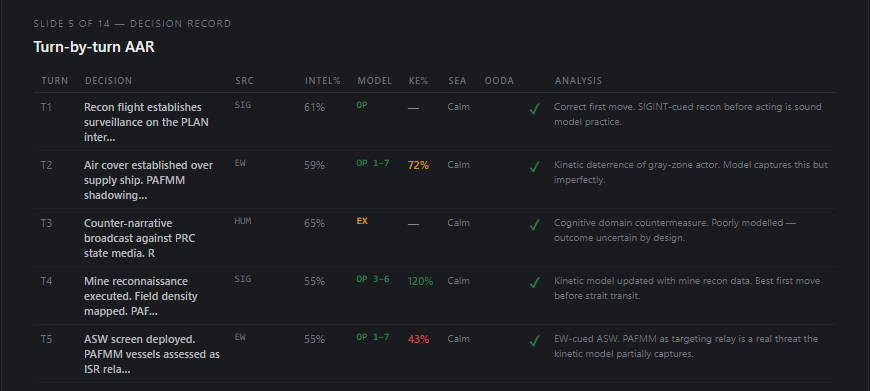
Every call is scored on one question: was your model still trustworthy when you trusted it? The debrief shows where it wasn't.
03
Contested logistics
Magazines, fuel, tempo — all finite. The enemy spends cheap to make you spend dear.
04
Play the adversary
A second player can take the enemy’s side. The vote stops being simulated — and the debrief scores the exchange head to head.
The debrief
Every campaign ends in evidence.
Not a score and a handshake. An after-action review generated from the player’s own decision record — what they chose, what it cost, and where their model stopped predicting the outcome.
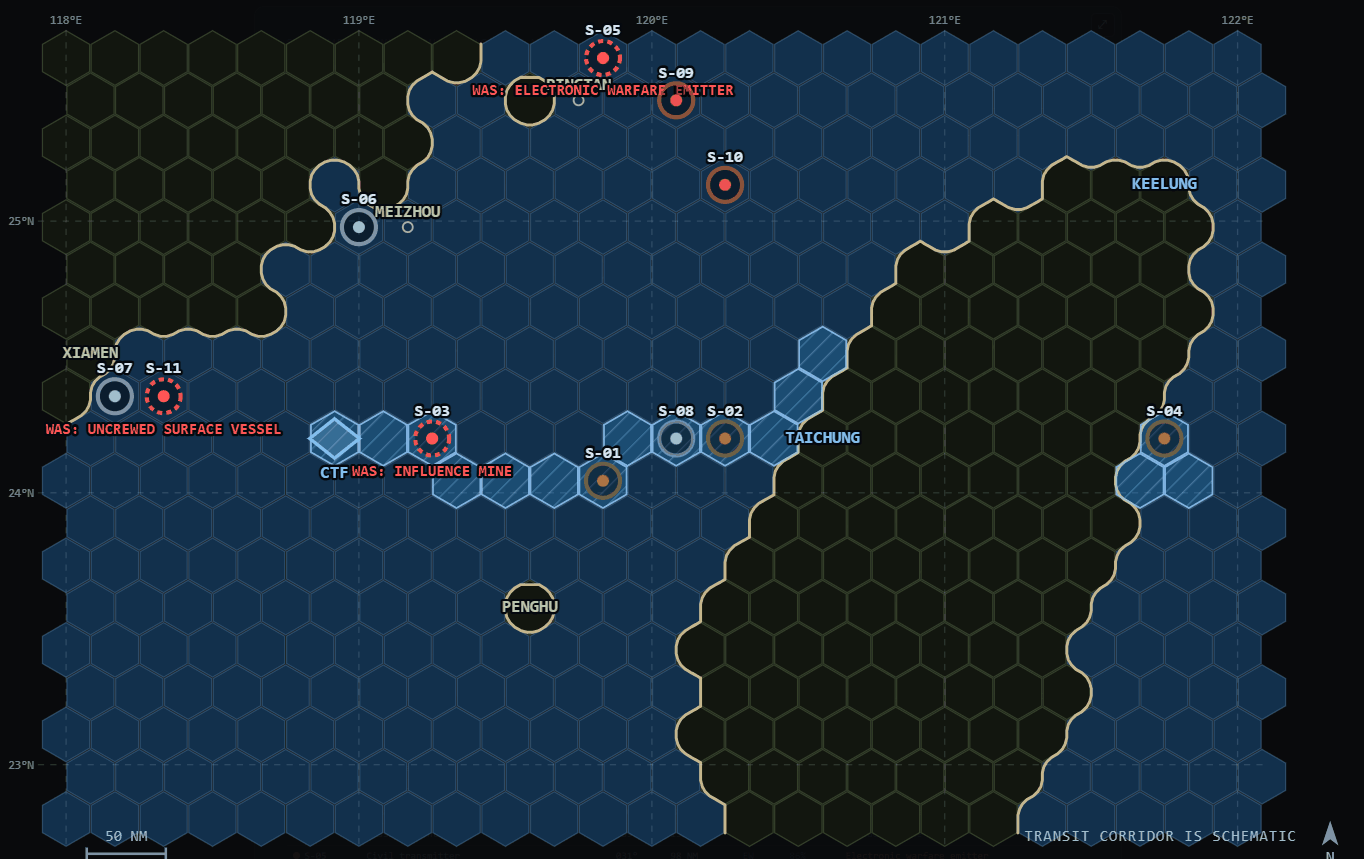
THE CHART THE PLAYER HELD Six contacts, mean confidence 48%. Every mark came from a sensor with its own reliability; none is confirmed.THE DEBRIEF, GROUND TRUTH ON The red ring is the contact the sensors got wrong. The debrief names it, and what believing it cost.
The gap between the two charts is the lesson. The debrief is built around it.
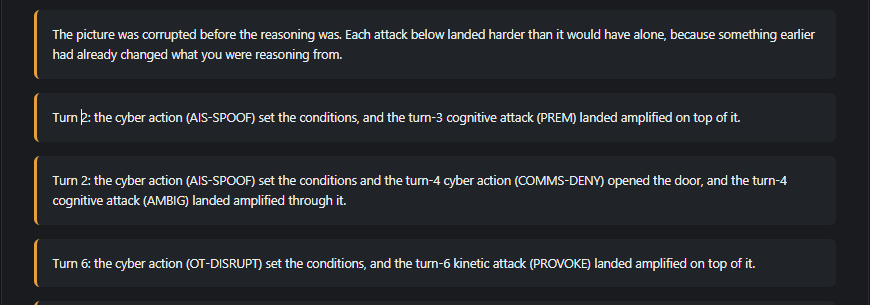
THE DECISION RECORD Every decision scored against model validity — was the model still trustworthy when you trusted it?THE SECOND CAMPAIGN What the cyber layer did to the cognitive one. Each attack landed harder because an earlier one had changed what you were reasoning from.
THE INSTRUCTOR’S DEBRIEF Written from the day’s campaigns before the class sits down — where the cohort split, what it missed, what to ask.
Campaigns
Distinct theaters. One question: does your model survive contact?
Persian Gulf
CHOKEHOLD — Strait of Hormuz
Respond to an escalating closure. Swarm, suicide USV, dhow-laid mines, coercive denial. The enemy plays to make transit not worth the cost.
Persian Gulf · Marines ashore
LONGSHADOW — Strait of Hormuz
Hunt a missile network that hides in caves and towns and rebuilds what you kill. The picture finds everything and confirms nothing; the Marines ashore do the confirming.
Gulf of Thailand
DEEPWATER — Ream Naval Base
Gray-zone A2/AD, maritime-militia ambiguity, and a logistics picture that degrades inside the strait.
Western Pacific
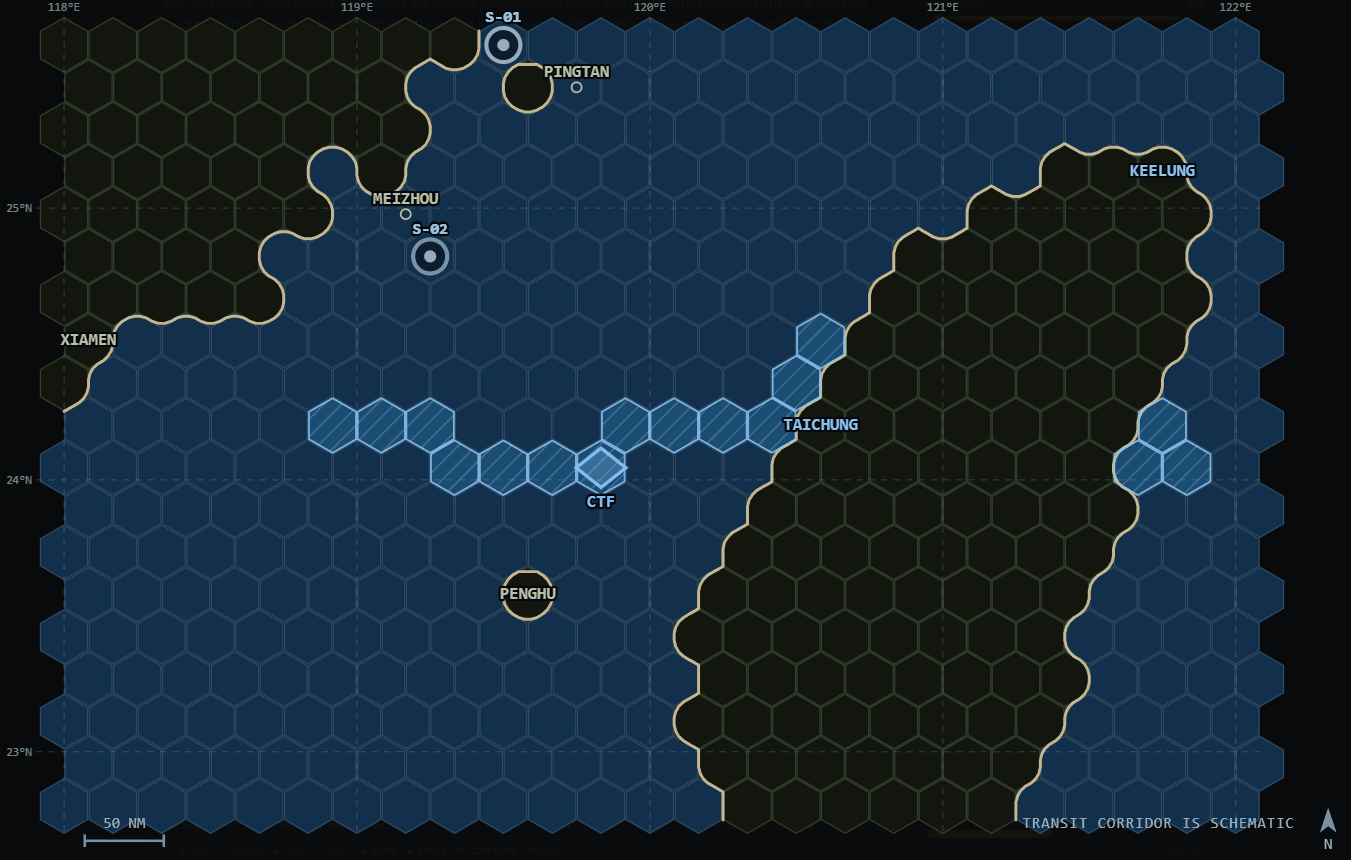
GAUNTLET — Taiwan Strait
A contested transit under coastal fires and persistent ISR — where every counter-move carries an escalation cost.
For instructors
One platform, a whole cohort.
A session is four moves: a concept check before anyone deploys, a campaign that fits in an afternoon, an after-action review generated from each player’s own decision record, and aggregate analytics across the class.
Pre-game assessment
Five questions on the concepts the scenario will test. You know what they believed going in.
The campaign
Eight to ten turns in a browser, on the laptops already in the room.
The debrief
Every decision paired with its outcome, generated per player. No two are alike.
Class analytics
Where the cohort clustered, which concepts they missed, who improved.
The debrief pairs what a student answered before the campaign against what they did during it — and shows them where the two diverged. That gap is the training objective.
How to engage
Three ways in. All of them end in a debrief.
01 · PILOT SESSION
One cohort, one afternoon.
Your instructor runs a live campaign with us in the room. The debrief is theirs to keep.
02 · COHORT LICENCE
The platform for a course or a term.
Pre-game assessment, campaigns, after-action reviews, and class analytics across the whole cohort.
03 · CUSTOM SCENARIO
A new theater from your threat set.
The engine doesn't change; the adversary does. We build the threat architecture with your subject-matter people.
Practical questions
What running it actually involves.
Is any of this classified?
No. Every scenario is built from open-source material and is marked Uncontrolled/General.
What do we need to run it?
A browser. Nothing to install, no hardware to buy, no network exceptions to request.
How long is a session?
One campaign runs in an afternoon — assessment, play, and debrief.
Can you build our scenario?
Yes. You bring the problem and the terrain; we build the threat model, the turn structure, and the decisions your people will have to make.
Who is it for?
Logistics officers, planners, and the people responsible for training them.
A research foundation drawn from the whole discipline.
The engine draws on decades of published defense operations research and decision science — the RAND analytical-wargaming tradition, and the thinking carried forward at the Hoover Institution, the Naval Academy’s wargaming department, West Point’s Modern War Institute, the JFK Special Warfare Center and School, and the Mitchell Institute for Aerospace Studies. Its method is older than the software: surface the key assumptions, force the competing hypotheses, keep what survives. The synthesis is ours.
The team
Three builders, three disciplines.
Aaron Myers
Engine & Adversary Design
Aaron founded Games of War and built its engine and its adversary. In Washington, D.C., he works as a contract dignitary and executive protection agent, and formerly carried secure correspondence into U.S. embassies and consulates as a contract courier for the State Department, with access few are ever granted. Since February 2022 he has coordinated humanitarian logistics into wartime Ukraine, and in 2020 served on the New York State Department of Health’s COVID-19 testing operation. He has completed CISA and DHS critical infrastructure training.
Sandra leads Games of War’s contested-logistics design. She is the founder of Thomas Strategy Consulting, where she advises defense and intelligence firms on supply chain resilience, critical minerals, and industrial base vulnerabilities. She is an Army logistics officer with more than nineteen years of experience, stateside and in combat. She served as defense industrial base chief on the Joint Staff J-4, where she ran wargames for the Joint Logistics Enterprise. Her writing on wargaming and the industrial base has appeared in War on the Rocks, Pacific Forum and National Defense.
Debra leads the Games of War cyber domain. She is founder and principal AI architect of Unicorn Data Works, where she builds enterprise AI and data systems for defense clients: agentic workflows, LLMOps, and zero-trust data governance on Palantir Foundry and Databricks. A Marine Corps veteran and former communications chief, she holds an M.S. in Applied Data Science and a C.A.S. in Information Security Management from Syracuse University, and an M.B.A. from Saint Leo University. She is the author of The Foundry FDE Field Manual.