The wargaming engine that adapts like the enemy does.
Maritime chokepoints, contested infrastructure, cyber, crisis response — the theaters change, the discipline doesn't. A new theater is a new threat set, not a new system.
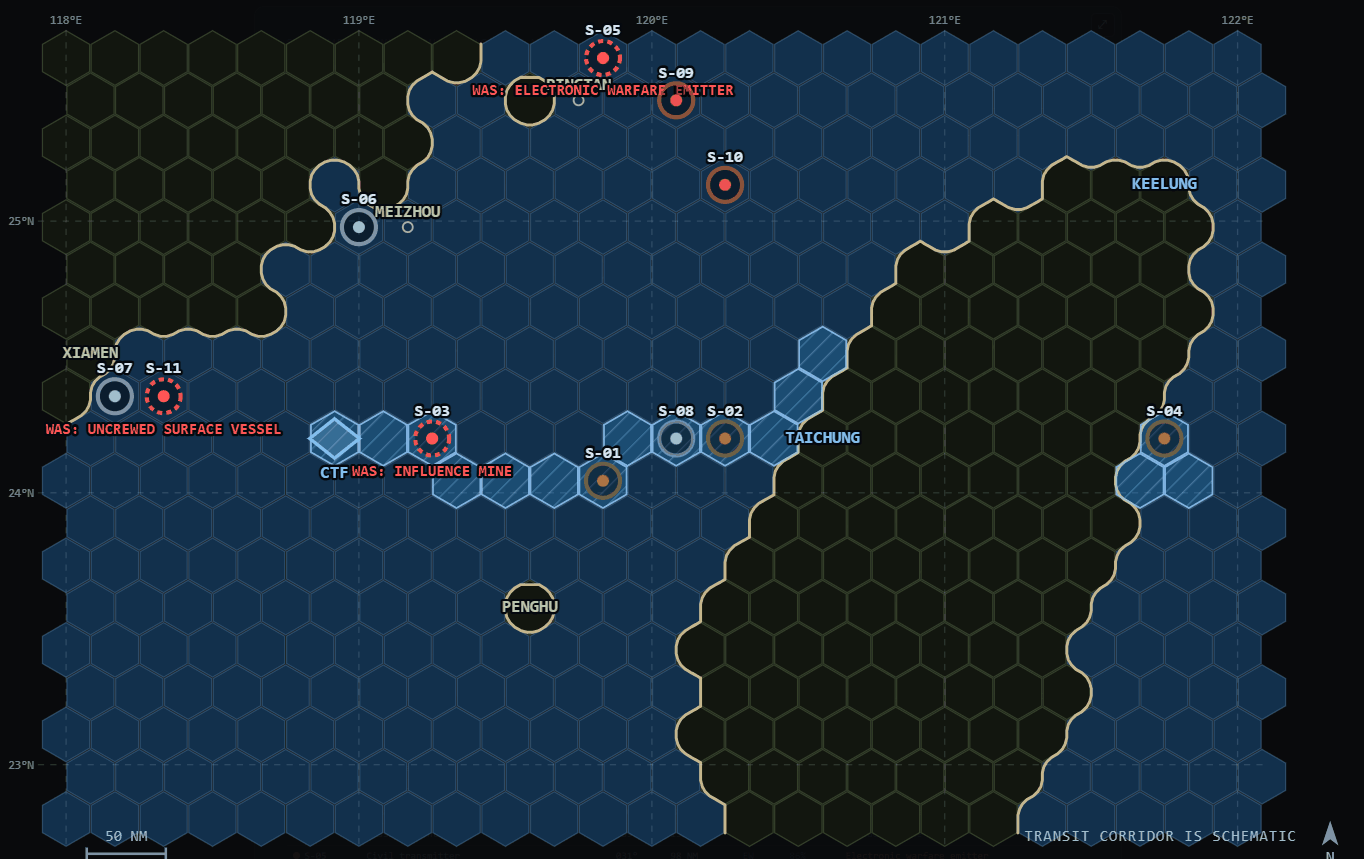
A capable adversary doesn't fight the war your doctrine was built to win. He targets your patience, exploits your rules of engagement, and turns your own assumptions into the weapon — mirror-imaging, doctrinal blindness, the tunnel vision that fixes you on the fight in front of you while the real blow lands somewhere else.
The physical battlefield is the easy part. The harder war is cognitive — and it's the one training usually skips.
Not a campaign simulator and not a supply-chain optimizer. A decision trainer — the reps happen where judgment meets a thinking adversary.
The threat escalates, reconstitutes, and coerces on its own logic — punishing mirror-imaging and rewarding the commander who questions the obvious read.
Every call is scored on one question: was your model still trustworthy when you trusted it? The debrief shows where it wasn't.
Magazines, fuel, tempo — all finite. The enemy spends cheap to make you spend dear.
A second player can take the enemy’s side. The vote stops being simulated — and the debrief scores the exchange head to head.
Not a score and a handshake. An after-action review generated from the player’s own decision record — what they chose, what it cost, and where their model stopped predicting the outcome.
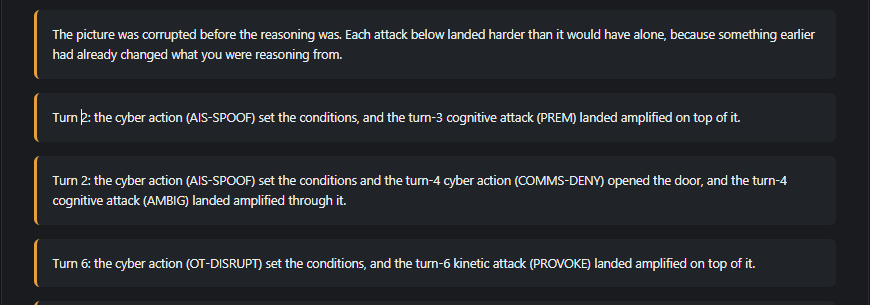
The gap between the two charts is the lesson. The debrief is built around it.
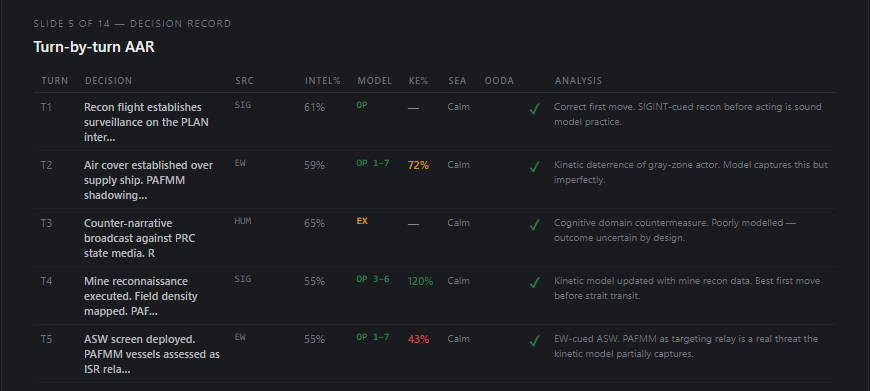


A session is four moves: a concept check before anyone deploys, a campaign that fits in an afternoon, an after-action review generated from each player’s own decision record, and aggregate analytics across the class.
The debrief pairs what a student answered before the campaign against what they did during it — and shows them where the two diverged. That gap is the training objective.
Your instructor runs a live campaign with us in the room. The debrief is theirs to keep.
Pre-game assessment, campaigns, after-action reviews, and class analytics across the whole cohort.
The engine doesn't change; the adversary does. We build the threat architecture with your subject-matter people.
The engine draws on decades of published defense operations research and decision science — the RAND analytical-wargaming tradition, and the thinking carried forward at the Hoover Institution, the Naval Academy’s wargaming department, West Point’s Modern War Institute, the JFK Special Warfare Center and School, and the Mitchell Institute for Aerospace Studies. Its method is older than the software: surface the key assumptions, force the competing hypotheses, keep what survives. The synthesis is ours.
A thirty-minute walkthrough on a call, or a pilot session in the room. No deck; we play a turn.
Suffer the intellectual defeats in a simulated crisis room — so your people don't suffer them in a real one.